

FUNDAMENTALS OF ACCOUNTING
This unit is designed to enable the learner achieve and apply the following key skills.
· By the end of this unit the learner should be able to :
1. Demonstrate understanding of accounting principles and policies.
2. Apply double entry concept.
3. Classify capital and liabilities.
4. Correct accounting errors and suspense account.
5. Prepare sole trader statement.
6. Prepare partnership statements.
7. Prepare company statements.
Course outline
TOPIC 1: Demonstrate Understanding of accounting principles and policies
1.1 Nature and purpose of accounting is established.
1.2 Users of accounting information and their information needs is established
1.3 Qualities of accounting information is determined
1.4 Accounting concepts/principles are identified
1.5 Accounting standards are determined
1.6 Accounting equation is prepared
TOPIC 2: Apply double entry concept
2.1 Accounting source documents are prepared
2.2 Books of original entry are determined
2.3 Double entry system is applied to prepare ledger accounts.
2.4 The trial balance and basic financial statements are prepared.
2.5 Computerized accounting systems is applied as per the accounting guidelines
TOPIC 3: Classify capital, liabilities and Assets
3.1 Accrued expenses and prepaid expenses are determined as per the accounting principles.
3.2 Accounting for revenue
3.3 Accounting for accounts receivables, bad debts and allowance for doubtful debts are determined.
3.4 Property plant and equipment accounts are managed 3.5 Inventory is recognized, measured and valued based on cost method.
3.6 Accounting for cash and cash equivalents, bank reconciliation
3.7 Accounts payable are accounted for including control account.
TOPIC 4: Correct accounting errors and suspense account
4.1 Errors that can be detected by the trial balance are determined.
4.2 Errors where the effect of the error causes the trial balance not to balance are identified.
4.3 Errors where the effect of the error causes the trial balance still balance are identified.
4.4 Procedures of correcting errors are determined as per the organization objectives.
4.5 Errors that can be corrected by suspense account are identified
4.6 Suspense account is prepared as per the SOPs.
TOPIC 5: Prepare sole trader statement
5.1 Sources of capital for sole trader are established
5.2 Sole trader Income statement is drafted as per accounting period.
5.3 Statement of financial position is prepared as per accounting period.
TOPIC 6: Prepare partnership statements
6.1 Contents of a partnership agreement are determined as per the SOPs.
6.2 Current and capital accounts are prepared as per the SOPs as per accounting standards.
6.3 Income Statement is prepared as per accounting standards.
6.4 Appropriation of profit and loss account is prepared.
6.5 Statement of financial is prepared as per the organizational requirements
TOPIC 7: Prepare company statements
7.1. Types of share capital are identified as company’s Act
7.2. Types of reserves are determined as per the organizational objectives.
7.3. Issue of shares is determined as per the organizational requirements
7.4. Rights issues and bonus are calculated as per the company polices
7.5. Provisions and reserves are identified
7.6. Income tax is calculated as per the SOPs.
7.7. Accounting treatment and presentation is conducted as per the accounting standards
7.8. Income statement is drafted as per the accounting standards.
7.9. Statement of financial position is prepared as per the accounting standards.

TOPIC 1. Nature and purpose of accounting is established
To establish the nature and purpose of accounting the learner should do the following activities:
a) Define the term accounting.
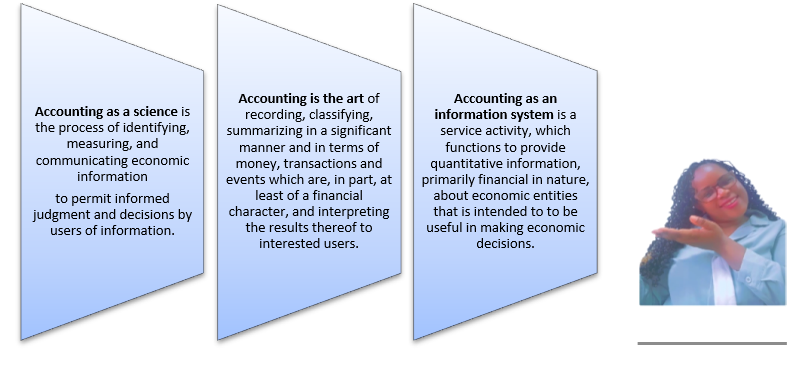
Accounting can be defined in three ways, that is, as a science, as an art and as an information system.
b) Identify the objectives of accounting?
The objectives of accounting can be given as follows:
1. To systematically record the financial aspects of business transactions i.e. book-keeping. These recorded transactions are later on classified and summarized logically for the preparation of financial statements and for their analysis and interpretation.
2. To ascertain profit and loss account resulting from business operations for a particular period of time.
3. To ascertain the financial position of the business – Businessman is not only interested in knowing the results of the business in terms of profits or loss for a particular period but is also anxious to know that what he owes (liability) to the outsiders and what he owns (assets) on a certain date. To know this, accountant prepares a financial position statement popularly known as Balance Sheet. The balance sheet is a statement of assets an
4. To provide information to the users for rational decision-making – Accounting like a language of commerce communes the monetary results of a venture to a variety of stakeholders by means of financial reports. Accounting aims to meet the information needs of the decision-makers and helps them in rational decision-making.
5. To know the solvency position: By preparing the balance sheet, management not only reveals what is owned and owed by the enterprise, but also it gives the information regarding concern’s ability to meet its liabilities in the short run (liquidity position) and also in the long run (solvency position) as and when they fall due.
Users of accounting information and their information needs is established
Use the following mnemonic to remember the seven users of accounting information:
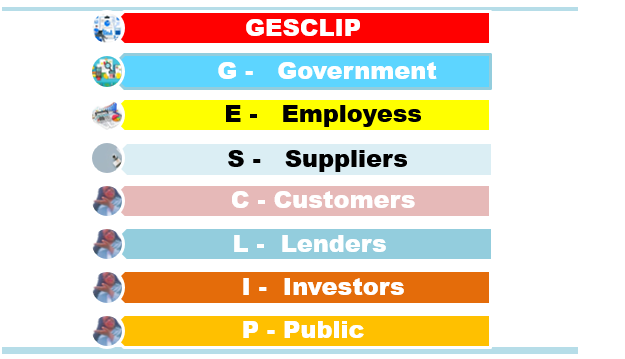
1. Government –The government needs accounting information to assess the amount of tax to be paid by a business or an individual (like the Bureau of Internal Revenue or the Internal Revenue Service when assessing income tax, estate tax, donor’s tax or other taxes); accounting information is needed when determining the fees to be charged in acquiring a business permit or a mayor’s permit; when the Securities and Exchange Commission determines the legality of the amount of share capital subscribed, accounting information is used; when the government deals with certain economic problems like inflation, still accounting information is used. Of course, this list could go on and on.
2. Employees – Employees need accounting information to know if the business could provide the necessary benefits that is due to them. Through accounting information, employees would not be in the dark with regards to the operations of the firm that they are working for.
3. Suppliers and Other Trade Creditors – suppliers and trade creditors are providers of merchandise on account to different business establishments. They would like to have accounting information of the business to be able to determine whether the business will be able to pay back the credit when it falls due.
4. Customers – Customers need accounting information in order to determine the continuity of a business, most especially when there is a long-term engagement between the parties or if the customer is dependent on the enterprise.
5. Lenders – Lenders have similar needs as suppliers wherein information that enable them to determine the ability of a client to pay their obligations and the interest attached when the loan becomes due.
6. Investors and Businessmen relevant decisions–
Through accounting information, they could determine whether to purchase stocks, sell stocks or hold the stock. Businessmen could determine which operations to continue or discontinue, which product line is profitable, and many more. They need to know about the financial performance, position, and cash flows of a business. Know about the financial performance, position, and cash flows of a business.
7. Public – include the institutions and welfare associations, they would like to have the accounting information of the firm to assess the firm’s corporate social responsibility.
8. Managers – they run the day to day operations of the business. They would like to have information on financial performance and financial position of the business to assess whether the business is making profits or loss and whether it is operating as per the plans.
1.3 Qualities of useful accounting information
1. Relevance
Relevance accounting information is the one that influences the economic decisions of the users by helping the evaluate past, present and future events of the business.If investors cannot review accounting information for a company and assess its financial worthiness, then the information is not relevant and fails the relevance test. If management cannot review accounting information and use it to make decisions concerning business operations, then the information fails the feedback test.
2. Timeliness
Timeliness is a quality subset of relevance. If you do not present accounting information in a timely manner, its usefulness to investors and managers is diminished or completely eliminated. The quality of timeliness requires both recording the financial transaction in the appropriate accounting period and generating accounting reports as soon as all data are posted so that issues with business operations are discovered before the problem grows.
3. Reliability
Accounting information should be reliable, to be used to make quality business decisions. In order to meet GAAP standards for reliability, accounting information must be verifiable, meaning you should be able to prove the authenticity and show a paper trail for every income and expense entry recorded to the accounting general ledger.
In order for accounting information to be reliable, it must also be neutral, meaning only GAAP standards were used when the accounting information was recorded; that is, the information was not recorded to reflect better on the company’s financial performance.
4. Consistency
In order for accounting information to be useful in decision making, it must be recorded consistently, meaning the same accounting treatment must be applied at all times to a given type of accounting data. Recording the same monthly expense in different expense accounts skews the expense categories and makes it harder to determine the actual expense in any one category.
5. Comparability
Comparability is a subset of consistency. Users should be able to compare accounting information for one period of time to another, to derive useful information in order to make operational decisions. Without consistency, any comparison of accounting data is useless, as the data compared will not have been created using the same methods or standards.
1.3 Accounting concepts/principles
Accounting Concepts and Principles are a set of broad conventions that have been devised to provide a basic framework for financial reporting. They are the basic assumptions that underlie the periodic financial accounts of business enterprises.
Following is a list of the major accounting concepts and principles:
Relevance · Reliability · Matching Concept · Timeliness
· Neutrality · Faithful Representation · Prudence · Completeness
Single Economic Entity · Money Measurement · Comparability/Consistency
Concept Concept
· Understandability · Materiality · Going Concern · Accruals
Business Entity · Substance over Form · Realization Concept · Duality Concept
Relevance
Information should be relevant to the decision making needs of the user. Information is relevant if it helps users of the financial statements in predicting future trends of the business (Predictive Value) or confirming or correcting any past predictions they have made (Confirmatory Value).
Reliability
Information is reliable if a user can depend upon it to be materially accurate and if it faithfully represents the information that it purports to present.
Reliability of financial information is enhanced by the use of following accounting concepts and principles:
1. Neutrality
2. Faithful Representation
3. Prudence
4. Completeness
5. Single Economic Entity Concept.
1. Neutrality
Information may be deliberately biased or systematically biased.
Deliberate bias: Occurs where circumstances and conditions cause management to intentionally misstate the financial statements e.g. A company is facing serious liquidity problems. Management may decide to window dress the financial statements in a manner that improves the company’s current ratios in order to hide the gravity of the situation.
Systematic bias: Occurs where accounting systems have developed an inherent tendency of favoring one outcome over the other over time. For instance Accounting policies within an organization may be overly prudent because of cultural influence of an over cautious leadership.
2. Faithful Representation
Information presented in the financial statements should faithfully represent the transaction and events that occur during a period.
3. Prudence
Prudence requires that accountants should exercise a degree of caution in the adoption of policies and significant estimates such that the assets and income of the entity are not overstated whereas liability and expenses are not under stated. A company should not recognize an asset at a value that is higher than the amount which is expected to be recovered from its sale or use. Conversely, liabilities of an entity should not be presented below the amount that is likely to be paid in its respect in the future.
4. Completeness
Reliability of information contained in the financial statements is achieved only if complete financial information is provided relevant to the business and financial decision making needs of the users.
5. Single Economic Entity Concept.
Single Economic Entity Concept suggests that companies associated with each other through the virtue of common control operate as a single economic unit and therefore the consolidated financial statements of a group of companies should reflect the essence of such arrangement.
Substance over form
Substance over form requires that if substance of transaction differs from its legal form than such transaction should be accounted for in accordance with its substance and economic reality. The rationale behind this is that financial information contained in the financial statements should represent the business essence of transactions and events not merely their legal aspects in order to present a true and fair view.
Money Measurement Concept
Money Measurement Concept in accounting, also known as Measurability Concept, means that only transactions and events that are capable of being measured in monetary terms are recognized in the financial statements.
Matching Principle & Concept
The Matching Principle requires that expenses incurred by an organization must be charged to the income statement in the accounting period in which the revenue, to which those expenses relate, is earned.
Matching Vs Accruals Vs Cash Basis
In the accounting community, the expressions ‘matching principle’ and ‘accruals basis of accounting’ are often used interchangeably. Accruals basis of accounting requires recognition of income and expenses in the accounting periods to which they relate rather than on cash basis. Accruals basis of accounting is therefore similar to the matching principle in that both tend to dissolve the use of cash basis of accounting.
Understandability
Transactions and events must be accounted for and presented in the financial statements in a manner that is easily understandable by a user who possesses a reasonable level of knowledge of the business, economic activities and accounting in general provided that such a user is willing to study the information with reasonable diligence.
Materiality
Information is material if its omission or misstatement could influence the economic decisions of users.
Materiality is also linked closely to other accounting concepts and principles:
Relevance: Material information influences the economic decisions of the users and is therefore relevant to their needs.
Reliability: Omission or misstatement of an important piece of information impairs users’ ability to make correct decisions taken on the basis of financial statements thereby affecting the reliability of information.
Completeness: Information contained in the financial statements must be complete in all material respects in order to present a true and fair view of the affairs of the company