This co-efficient of correlation was developed by A British psychologist named Charles Edward Spearman in 1904.
It is also called Spearman’s Rank Co-efficient of correlation.
Spearman defined this correlation as: The measure the strength and direction of the relationship between two variables based on their ranks rather than their actual numerical values.
He found that there exist two types of problems:
- Where ranks were given.
- Where ranks were not given
Calculating Rank co-efficient of correlation is simple compared to Karl Pearson’s coefficient of correlation. However, this post challenges us to calculate rank coefficient of correlation where more than two ranks are given.
Remember
The formula of for calculating rank co-efficient of correlation is given as :
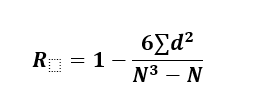
Where R= Rank co-efficient of correlation
D = difference between ranks
N = number of pairs between ranks
Illustration
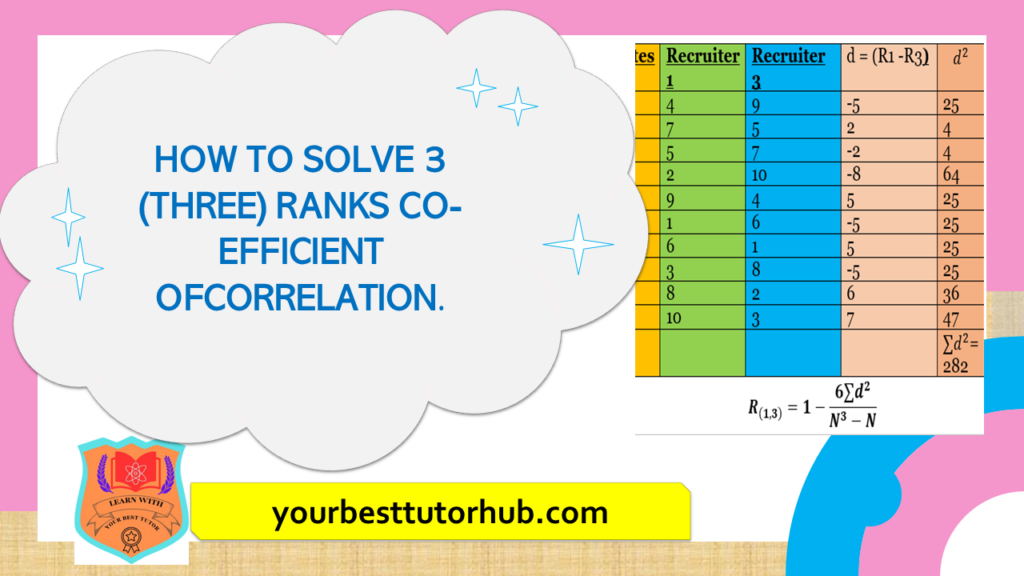
- Three independent recruiters ranked 10 candidates based on their technical performance during a high-stakes assessment. The results are captured in the table below:
| Candidate | Recruiter 1 | Recruiter 2 | Recruiter 3 |
| A | 4 | 4 | 9 |
| B | 7 | 6 | 5 |
| C | 5 | 10 | 7 |
| D | 2 | 3 | 10 |
| E | 9 | 8 | 4 |
| F | 1 | 2 | 6 |
| G | 6 | 9 | 1 |
| H | 3 | 1 | 8 |
| I | 8 | 5 | 2 |
| J | 10 | 7 | 3 |
- Determine the Spearman’s Rank Correlation Coefficient for every possible pair of recruiters.
- Based on your calculations, identify which pair of recruiters has the lowest correlation, indicating they are the most inconsistent in their evaluation criteria.
Solution
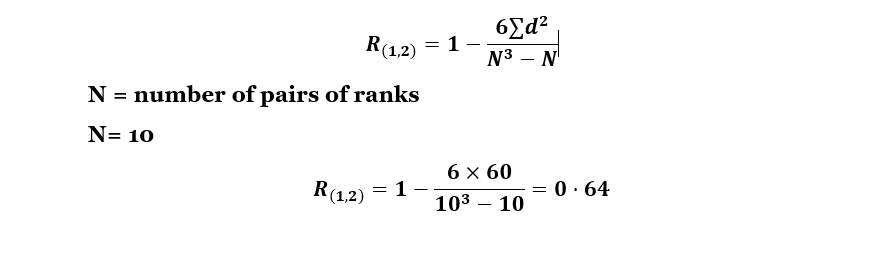
- Recruiter 1 and 2
| Candidates | Recruiter 1 | Recruiter 2 | d = (R1 -R2) | |
| A | 4 | 4 | – | – |
| B | 7 | 6 | 1 | 1 |
| C | 5 | 10 | -5 | 25 |
| D | 2 | 3 | -1 | 1 |
| E | 9 | 8 | 1 | 1 |
| F | 1 | 2 | -1 | 1 |
| G | 6 | 9 | -3 | 9 |
| H | 3 | 1 | 2 | 4 |
| I | 8 | 5 | 3 | 9 |
| J | 10 | 7 | 3 | 9 |
| sum d^2 = 60 |
Recruiter 2 and 3
| Candidates | Recruiter 2 | Recruiter 3 | d = (R2 -R3) | d^2 |
| A | 4 | 9 | -5 | 25 |
| B | 6 | 5 | 1 | 1 |
| C | 10 | 7 | 3 | 9 |
| D | 3 | 10 | -7 | 49 |
| E | 8 | 4 | 4 | 16 |
| F | 2 | 6 | -4 | 16 |
| G | 9 | 1 | 7 | 49 |
| H | 1 | 8 | -7 | 49 |
| I | 5 | 2 | 3 | 9 |
| J | 7 | 3 | 4 | 16 |
| sum d^2= 254 |
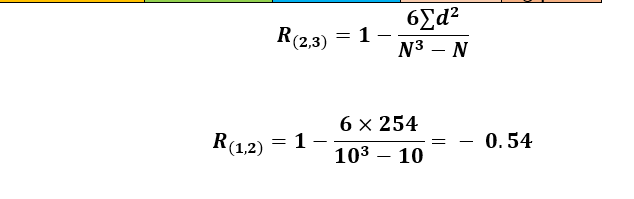
recruiter 1,3
| Candidates | Recruiter 1 | Recruiter 3 | d = (R1 -R3) | d^2 |
| A | 4 | 9 | -5 | 25 |
| B | 7 | 5 | 2 | 4 |
| C | 5 | 7 | -2 | 4 |
| D | 2 | 10 | -8 | 64 |
| E | 9 | 4 | 5 | 25 |
| F | 1 | 6 | -5 | 25 |
| G | 6 | 1 | 5 | 25 |
| H | 3 | 8 | -5 | 25 |
| I | 8 | 2 | 6 | 36 |
| J | 10 | 3 | 7 | 47 |
| sum d^2= 282 |

ii) The pair of recruiters who are most inconsistent is Recruiter 1 and recruiter 2. They have a strong negative correlation of -0.71.
Check out this KNEC question on https://easytvet.com/3/dict/pdf/pp/mod3/Quantitative_methods/2023j.pdf
SELF ASSESSMENT- try these questions out and comment your answers.
A panel of three assessors independently ranked 10 contestants in a fashion showcase. Rank 1 represents the best performance and rank 10 the least impressive.
The rankings are shown below:
| Contestant | Assessor A | Assessor B | Assessor C |
|---|---|---|---|
| P | 2 | 3 | 5 |
| Q | 6 | 5 | 4 |
| R | 1 | 2 | 3 |
| S | 4 | 6 | 7 |
| T | 8 | 7 | 6 |
| U | 3 | 1 | 2 |
| V | 5 | 4 | 8 |
| W | 7 | 8 | 9 |
| X | 9 | 10 | 10 |
| Y | 10 | 9 | 1 |
Required:
a) Calculate Spearman’s rank correlation coefficient for each of the following pairs of assessors:
(i) Assessor A and Assessor B
(ii) Assessor A and Assessor C
(iii) Assessor B and Assessor C
b) Based on your results in (a), identify which pair of assessors shows the least agreement in their rankings and give a brief reason for your answer.