
What is Business Research?
Business Research refers to a broader, more detailed study of all business areas. It includes the market and the customers but focuses on using that information to maximize sales and profit.
From my own experience, I’ve observed a dangerous trend in the market: most businesses simply do not invest enough in formal research. Instead, many founders rely on the ‘trial and error’ method—essentially gambling with their capital and hoping for the best. While trial and error might work for small, everyday tasks, it is a recipe for disaster when scaling a global enterprise. Today, I want to show you why moving from ‘guesswork’ to ‘systematic research’ is the most important investment you will ever make.
What Exactly is Research?
To master research, we must first define it. I rely on two academic pillars that help my students grasp the depth of this discipline:
Clifford Woody’s Perspective: He views research as a rigorous cycle. It involves defining and redefining problems, formulating hypotheses (suggested solutions), organizing and evaluating data, and—most crucially—reaching deductions and testing them against the original problem.
Crawford’s Definition: Crawford sees it as a “refined technique of thinking.” It’s the use of specialized tools and procedures to find solutions that “ordinary means” simply cannot uncover.
Research is not just “looking things up.” It is a systematic, scientific approach to solving business difficulties.
Understanding the Core Concepts of Business Research and Marketing
Before exploring advanced research methods and marketing strategies, it is important to understand the basic concepts that guide all research activities. Many learners and business owners struggle not because the subject is difficult, but because these concepts are often misunderstood or confused.
Basic Concept in Business Research
1. Research Problem – Where Research Begins
A research problem is the starting point of any research project. .It refers to a specific issue, challenge, or gap in knowledge that needs to be addressed.
If there is no problem to solve, there is no reason to conduct research. A clear research problem:
- Identifies what is missing or not working
- Gives direction to the research process
- Helps define objectives and research questions
Simply put, good research always begins with a clearly defined problem.
2. Customer Feedback – The Voice of the Customer
Customer feedback is the direct response from people who use a product or service. It shows whether customers are satisfied, dissatisfied, or neutral about their experience.
This information can come from:
- Online reviews and ratings
- Surveys and feedback forms
- Complaints, comments, and suggestions
Customer feedback is one of the most honest and valuable sources of data. Businesses use it to improve products, enhance customer experience, and build stronger relationships with their audience.
3. Market Research – Understanding the Market
Market research is a structured process of collecting and analyzing information about customers, competitors, and market trends.
Its main purpose is to help businesses:
- Discover new opportunities
- Understand customer needs and preferences
- Reduce risks when making marketing decisions
By analyzing customer insights and market data, businesses can predict trends and make smarter strategic choices.
4. Marketing Information System (MIS) – Managing Marketing Data
A Marketing Information System (MIS) is a system that organizes and manages marketing information. It combines people, technology, and processes to collect and analyze data continuously.
An MIS helps organizations:
- Track market performance
- Support marketing research activities
- Provide timely information for decision-making
Unlike one-time research studies, an MIS works continuously, ensuring that managers always have access to reliable information
5. Business Research – Supporting Smart Business Decisions
Business research involves the systematic study of all areas of a business, including marketing, operations, finance, and customer behavior.
The goal of business research is to:
- Improve decision-making
- Reduce uncertainty and risk
- Increase sales, efficiency, and profitability
Market Research vs. Business Research
Market Research: A systematic process for identifying marketing opportunities and solving marketing problems using customer insights.
Business Research: A broader, more detailed study of all business areas. It includes the market and the customers but focuses on using that information to maximize sales and profit.
Types of Business Research
This is the “Bread and Butter” of my methodology lectures. You must choose the right tool for the job.
A. Quantitative Research (The “What” and “How Many”)
This method analyzes the largest group that meets your target goals using mathematical techniques. It answers questions like:
- How many people are interested in my service?
- Who are my best customers based on buying habits?
- The Numerical Proof: For example, “70% of prospective customers use the Internet to book a hotel room.”
B. Qualitative Research (The “Why” and “How”)
This focuses on attitudes, intentions, and beliefs. It’s about gaining deep insights into behavior.
The Strategic Importance to Business
Why invest time and money in research? In my experience, businesses that ignore research are simply planning to fail. Research allows you to:
- Supports Better Decision-Making: Research provides accurate information so businesses can make informed, confident decisions.
- Reduces Business Risk by identifying potential problems early, research helps avoid costly mistakes.
- Improves Customer Satisfaction and Loyalty: Understanding customer needs allows businesses to deliver better products and services.
- Identifies Market Opportunities: Research uncovers unmet needs and emerging trends for business growth.
- Enhances Competitive Advantage: Knowledge of competitors and market trends strengthens positioning and strategy.
- Supports Long-Term Strategic Planning: Continuous research helps businesses set realistic goals and adapt to change.
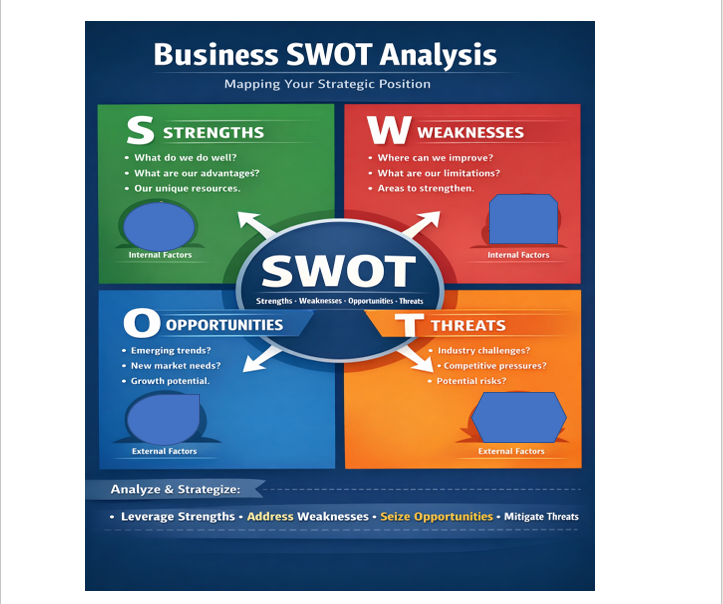
- Identify Opportunities & Threats: Use tools like SWOT Analysis (Strengths, Weaknesses, Opportunities, Threats) to map your position.
Methods of Gathering Data in Business Research
A researcher is only as good as their data sources. Reliable, relevant data leads to accurate conclusions, while weak data leads to poor decisions. Below are the most used and effective methods for gathering research information.
- Surveys and Questionnaires
Surveys and questionnaires are structured tools used to collect information from a specific group of people. They are especially useful when you need measurable and comparable data.
They help researchers:
- Measure customer satisfaction and preferences
- Understand opinions, beliefs, and attitudes
- Collect data from a large audience quickly
Surveys can be conducted online, face-to-face, or via mobile platforms, making them cost-effective and easy to analyze.
Click here to learn more about surveys:
2. Customer Feedback
Customer feedback is direct information provided by people who interact with a product or service. It reflects real experiences rather than assumptions.
This data may come from:
- Emails and customer support tickets
- Phone calls and chat conversations
- Online reviews, ratings, and social media comments
Because it comes straight from users, customer feedback is highly valuable and authentic. Businesses use it to improve service quality, fix weaknesses, and strengthen customer relationships.
3. Interviews
Interviews involve direct, one-on-one or group conversations with respondents. They allow researchers to explore topics in greater depth.
Interviews are useful for:
- Understanding motivations and behavior
- Clarifying survey responses
- Collecting detailed personal or expert opinions
They can be structured, semi-structured, or unstructured depending on the research objective.
4. Focus Groups
Focus groups bring together a small group of participants to discuss a topic guided by a moderator.
They help researchers:
- Observe reactions and group opinions
- Test ideas, products, or concepts
- Identify shared concerns and expectations
Focus groups are especially useful in marketing and product development research.
5. Observation
Observation involves watching and recording how people behave in real-life situations without directly interacting with them.
This method is useful for:
- Studying customer buying behavior
- Understanding how products are actually used
- Identifying patterns that respondents may not report
Observation provides realistic insights that are free from respondent bias.
6. Case Studies
Case studies involve the detailed analysis of specific organizations, industries, or events to understand how decisions are made and problems are solved.
They help researchers:
- Examine successful and failed strategies
- Understand market responses to change
- Apply lessons to similar situations
For example, analyzing retail shifts in the Kenyan market can reveal how businesses adapt to digital transformation and changing consumer behavior.
7. Secondary Data Sources
Secondary data refers to information that already exists and was collected by others.
Common sources include:
- Government publications and reports
- Industry reports and academic journals
- Company records and online databases
You have come to the end of this helpful post.
Before you leave, remember, defining your research problem is the first step. If you’re struggling to frame your statement of the problem, click the WhatsApp join button below. Let’s build your global strategy together.”
Also check out on our next post: How to frame a research statement of problem.