
What Is Customer Satisfaction
Customer satisfaction is a complex concept that significantly influences whether customers remain loyal to an organization or seek alternatives. It is shaped by multiple factors, including the quality of products and services, website usability, customer service interactions, and even the design and tone of communication such as emails sent to customers. When customers are satisfied, organizations benefit through increased sales, stronger customer retention, and the transformation of customers into brand ambassadors who actively promote the brand to others. As a result, measuring and managing customer satisfaction is a strategic priority for modern organizations.
Definitions of Key Terms
Customer Satisfaction
Customer satisfaction refers to the degree to which a company’s products, services, and overall customer experience meet or exceed customer expectations. High levels of satisfaction often result in repeat purchases, positive word-of-mouth, and long-term customer loyalty.
Customer Satisfaction Survey
A customer satisfaction survey is a structured questionnaire that organizations distribute to customers after a purchase or service interaction. The main purpose of the survey is to collect feedback on customer experiences, perceptions, and satisfaction levels in order to improve products, services, and overall business performance.
Methods, Processes, and Guidelines for Conducting Customer Satisfaction Surveys
Conducting customer satisfaction surveys requires a systematic approach to ensure accurate, reliable, and actionable feedback. Organizations must first define the objective of the survey, select an appropriate survey type, choose the right distribution channel, and ensure that the feedback collected is analyzed and acted upon. Surveys should be concise, easy to understand, and designed to encourage honest responses from customers.
Types of Customer Satisfaction Surveys
1. Net Promoter Score (NPS) Survey
The Net Promoter Score (NPS) survey is used to measure customer loyalty and overall customer sentiment toward an organization. It is based on a single question that asks customers how likely they are to recommend a company, product, or service to a friend or colleague. Responses are scored on a scale from 0 (not at all likely) to 10 (extremely likely).
NPS surveys are widely used across industries because they allow organizations to benchmark their performance against competitors. They help identify promoters, passives, and detractors. Detractors are customers who are dissatisfied and may switch to competitors or spread negative feedback, making NPS a valuable tool for retention strategies.
NPS Survey Question Example:
“How likely are you to recommend our company to a friend or colleague?”
(Scale: 0–10, followed by an optional open-ended comment)
2. Customer Satisfaction (CSAT) Survey
The Customer Satisfaction (CSAT) survey measures how satisfied customers are with a specific product or service. Unlike NPS, which focuses on loyalty, CSAT focuses on immediate satisfaction. Customers are asked to rate their satisfaction on a scale from 1 (Very Unsatisfied) to 5 (Very Satisfied).
Only customers who select “Satisfied” or “Very Satisfied” are considered satisfied. The CSAT score is calculated by dividing the number of satisfied customers by the total number of respondents and multiplying the result by 100. CSAT surveys help organizations evaluate whether their offerings meet customer expectations and identify areas that require improvement.
3. Post-Purchase Survey
Post-purchase surveys are distributed after a customer completes a transaction. These surveys focus on the customer’s specific experience with a particular purchase rather than overall loyalty. They help organizations identify strengths and weaknesses in areas such as customer service, delivery, pricing, and product quality.
Post-purchase surveys often include rating scales such as “Strongly Disagree” to “Strongly Agree” or “Poor” to “Excellent,” along with open-ended questions that allow customers to explain their responses in detail.
4. Product or Service Development Survey
Product development surveys, also known as concept testing surveys, are conducted before launching a new product or service. Their main purpose is to assess customer interest, perceived value, and likelihood of purchase. These surveys also allow organizations to gather feedback and make improvements before full-scale market introduction.
Customers are shown a prototype or concept, including pricing, and asked to evaluate its appeal, value for money, and overall quality. These surveys are most effective when sent to loyal or high-value customers who are familiar with the brand.
5. Usability Survey
Usability surveys are used primarily by online businesses to evaluate customer experience on websites or digital platforms. These surveys often appear as pop-ups while users are browsing and focus on ease of navigation, content clarity, and overall user satisfaction.
Usability surveys help organizations improve website design, streamline navigation, enhance content delivery, and reduce customer frustration. They may include multiple-choice questions, open-ended questions, or live chat features that guide users in real time.
Integrating Customer Satisfaction Surveys into Business Operations
To effectively integrate customer satisfaction surveys, organizations should follow a structured process. First, they must clearly determine the purpose of the survey and identify the insights they aim to gain. This ensures the correct survey type is selected. Next, the organization should choose an appropriate medium such as email, SMS, in-app surveys, website pop-ups, or face-to-face interactions.
After selecting the medium, a suitable survey tool should be chosen based on cost, functionality, and long-term business needs. Organizations must then establish a clear process for survey execution, including timing, responsibilities, and communication with employees. Feedback should be gathered, analyzed regularly, and shared with relevant teams. Most importantly, organizations must implement changes based on survey insights to improve customer experience.
Sharing Survey Results
Survey results should be presented using clear data visualizations and measurable indicators to show trends over time. Reports intended for customers should emphasize transparency and demonstrate that customer feedback is valued. Reports prepared for management should focus on insights that support strategic decision-making and business growth.
Acting Based on Survey Insights
The insights obtained from customer satisfaction surveys should guide future business decisions. Organizations should identify customer segments that are at risk of leaving and address the sources of dissatisfaction. At the same time, highly satisfied customers should be analyzed to identify characteristics that can attract similar customer profiles. This data-driven approach enables organizations to enhance retention, improve service quality, and strengthen competitive advantage.
Online Customer Surveys
Meaning of Online Customer Surveys
Online customer surveys are structured questionnaires administered through digital platforms such as websites, email, mobile applications, and social media to collect customer opinions, perceptions, and experiences. They enable organizations to gather feedback efficiently, quickly, and cost-effectively from a large number of customers regardless of geographical location.
Online surveys are widely used to measure customer satisfaction, customer loyalty, service quality, and user experience. Because responses are captured electronically, results can be analyzed in real time to support timely decision-making.
Types of Online Customer Surveys
Online customer surveys may take different forms depending on the objective of the organization. Common types include customer satisfaction surveys, Net Promoter Score (NPS) surveys, post-purchase surveys, usability surveys, and product development surveys. Each type focuses on a specific aspect of the customer experience, such as loyalty, satisfaction with a transaction, website usability, or reactions to new products.
How to Carry Out an Online Customer Survey
Identifying the Purpose of the Survey
The first step in conducting an online customer survey is clearly defining its objective. The organization must determine what information it needs, such as measuring satisfaction, identifying service gaps, evaluating a product, or improving customer retention. A clear purpose ensures the survey collects relevant and useful data.
Selecting the Target Audience
After defining the objective, the organization identifies the group of customers to be surveyed. This may include recent buyers, loyal customers, first-time users, or website visitors. Selecting the right audience improves the accuracy and relevance of survey results.
Designing the Survey Questionnaire
The questionnaire should contain clear, concise, and unbiased questions. A combination of closed-ended questions (such as rating scales and multiple-choice questions) and open-ended questions should be used. The survey should be short to avoid respondent fatigue and designed in a logical flow.
Choosing the Online Survey Platform
Organizations must select an appropriate digital platform to distribute the survey. Common platforms include email survey tools, website pop-up surveys, mobile app surveys, and social media links. The chosen platform should be easy to use, secure, and capable of analyzing responses.
Distributing the Survey
The survey link is shared with respondents through selected channels such as email, SMS, websites, or social media. Timing is important; surveys should be sent when the customer experience is still fresh, such as immediately after a purchase or service interaction.
Collecting and Monitoring Responses
As responses are received, the organization monitors participation rates and ensures sufficient data is collected. Follow-up reminders may be sent to improve response rates. Data collection should continue until a representative sample is achieved.
Analyzing the Survey Data
Collected data is analyzed using statistical tools and software. Quantitative data is summarized using percentages, averages, and scores, while qualitative responses are grouped into themes. Patterns and trends are identified to draw meaningful conclusions.
Reporting Findings and Taking Action
The final step involves preparing a survey report that summarizes key findings and provides recommendations. Management should use the insights gained to improve customer service, products, processes, and overall customer experience.
Benefits of Customer Satisfaction Surveys
Improves Customer Satisfaction
Customer satisfaction surveys help organizations understand customer needs and expectations. By addressing identified gaps, businesses can enhance service quality and customer experiences.
Enhances Customer Loyalty and Retention
When customers see that their feedback leads to improvements, they feel valued. This strengthens loyalty, encourages repeat business, and reduces customer turnover.
Supports Informed Decision-Making
Survey data provides factual evidence that supports strategic and operational decisions. Organizations can prioritize improvements based on customer input rather than assumptions.
Identifies Service and Product Gaps
Customer satisfaction surveys highlight weaknesses in service delivery, product quality, or communication. Early identification allows organizations to correct issues before they escalate.
Encourages Continuous Improvement
Regular use of customer satisfaction surveys enables organizations to track performance over time. This supports continuous improvement and long-term competitiveness.
Enhances Brand Image and Reputation
Organizations that actively seek and act on customer feedback build a positive reputation. Satisfied customers are more likely to recommend the organization to others.
Increases Sales and Profitability
Improved satisfaction and loyalty result in repeat purchases, positive word-of-mouth, and reduced marketing costs, ultimately contributing to higher profitability.
CUSTOMER FEEDBACK REPORT
Customer Feedback Report
A customer feedback report is a structured document that summarizes, analyzes, and interprets feedback collected from customers about a company’s products, services, or overall experience. The report is developed using data gathered through tools such as customer satisfaction surveys, interviews, online reviews, focus groups, or suggestion forms. Its main purpose is to help an organization understand customer perceptions, identify strengths and weaknesses, and make informed decisions aimed at improving customer satisfaction and business performance.
A customer feedback report presents key findings, trends, customer opinions, and actionable recommendations. By translating raw feedback into meaningful insights, the report enables management and staff to clearly understand how customers experience the organization and where improvements are required.
Benefits of a Customer Feedback Report to a Business Organization
Improves customer satisfaction
Customer feedback reports help organizations identify gaps between customer expectations and actual service delivery. Addressing these gaps leads to improved customer experiences and higher satisfaction levels.
Enhances customer loyalty and retention
When businesses respond to customer feedback, customers feel valued and respected. This strengthens trust, encourages repeat purchases, and reduces customer churn.
Supports better decision-making
Customer feedback reports provide reliable, data-driven insights that guide managerial decisions. Organizations can base improvements on real customer opinions rather than assumptions.
Identifies areas for improvement
The report highlights recurring complaints, service weaknesses, and operational inefficiencies. This enables organizations to prioritize actions and allocate resources effectively.
Encourages continuous improvement
Regular preparation of customer feedback reports promotes a culture of continuous improvement. Organizations can track satisfaction trends over time and assess the impact of changes made.
Strengthens product and service quality
By analyzing customer feedback on specific products or services, organizations can improve quality, refine features, and better meet customer needs.
Improves employee performance and accountability
Customer feedback reports make employees aware of how their actions influence customer experiences. This encourages accountability and motivates better service delivery.
Enhances brand reputation
Organizations that listen to and act on customer feedback build a positive public image. Satisfied customers are more likely to recommend the organization to others.
Increases competitive advantage
Understanding customer preferences and dissatisfaction enables organizations to differentiate themselves from competitors and respond effectively to market changes.
Drives business growth and profitability
Higher customer satisfaction and loyalty lead to increased sales, lower marketing costs, and sustainable business growth.
Components of a Customer Feedback Report
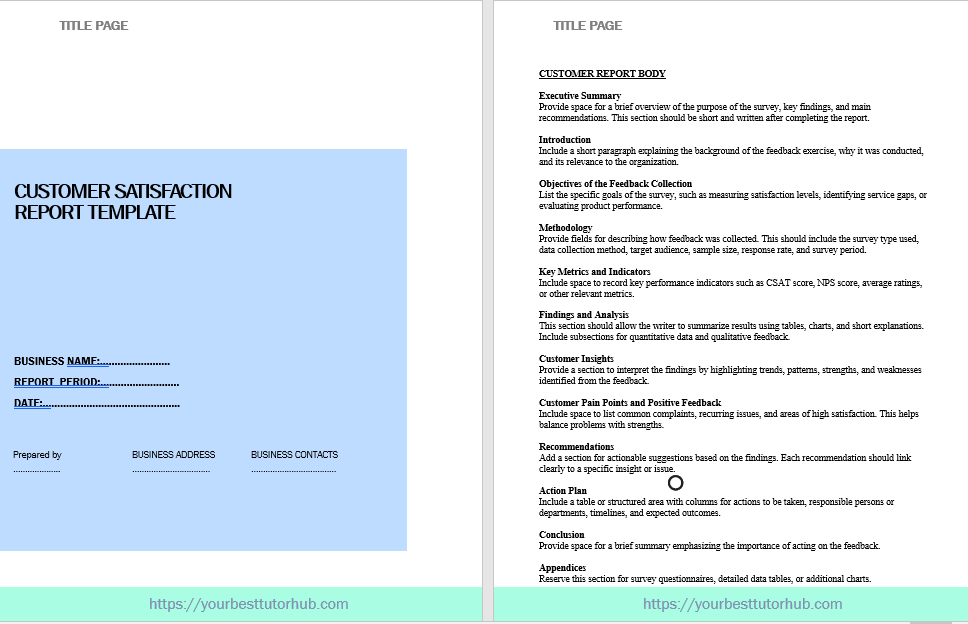
1. Title Page
The title page identifies the report and provides basic reference information. It usually includes the title of the report, the organization or department, the reporting period, and the date of submission. This helps readers quickly understand the scope and relevance of the report.
2. Executive Summary
The executive summary provides a concise overview of the entire report. It highlights the purpose of the feedback collection, the methods used, key findings, and major recommendations. This section allows senior management to understand the main insights without reading the full report.
3. Introduction
The introduction explains the background and purpose of the customer feedback report. It outlines why the feedback was collected, the business problem or objective being addressed, and the importance of customer feedback to the organization. This section sets the context for the report.
4. Objectives of the Report
This section clearly states what the organization intended to achieve through the feedback process. Objectives may include measuring customer satisfaction, identifying service gaps, evaluating product performance, or improving customer retention. Clearly defined objectives guide both analysis and interpretation of results.
5. Methodology
The methodology section describes how the customer feedback was collected. It includes the type of survey used (e.g., NPS, CSAT, post-purchase), data collection tools, sample size, target audience, response rate, and data collection period. This section ensures transparency and credibility.
6. Data Analysis and Findings
This is the core section of the report. It presents the results of the feedback in a clear and logical manner using charts, tables, percentages, and key statistics. Trends, patterns, and significant responses are highlighted. Both quantitative data (scores, ratings) and qualitative data (comments, themes) are analyzed.
7. Key Insights and Interpretation
This section explains what the results mean for the organization. It connects the data to business performance by identifying strengths, weaknesses, opportunities, and areas of concern. Interpretation goes beyond numbers to explain customer behavior and expectations.
8. Customer Pain Points and Positive Feedback
Here, the report summarizes major customer complaints, recurring issues, and service gaps, alongside positive feedback and areas where the organization is performing well. This balanced approach helps management understand what to fix and what to maintain or enhance.
9. Recommendations
Recommendations provide practical, actionable steps based on the findings. They may include improving customer service training, redesigning processes, enhancing product features, or adjusting communication strategies. Each recommendation should be clearly linked to a specific insight from the data.
10. Action Plan (Optional but Recommended)
An action plan outlines how recommendations will be implemented. It includes specific actions, responsible departments or individuals, timelines, and performance indicators. This section ensures that feedback leads to measurable improvement.
11. Conclusion
The conclusion summarizes the overall findings and reinforces the importance of acting on customer feedback. It highlights how the insights gained can improve customer satisfaction, loyalty, and organizational performance.
12. Appendices
Appendices contain supporting materials such as survey questionnaires, detailed data tables, graphs, or raw comments. These are included for reference without interrupting the flow of the main report.
How to Write a Customer Feedback Report
Step 1: Define the Purpose
Clearly identify why the report is being written. Determine whether the goal is to measure satisfaction, reduce churn, improve service quality, or support strategic decision-making.
Step 2: Organize the Data
Collect and clean the feedback data. Group responses into themes such as service quality, pricing, communication, and product performance. Separate quantitative scores from qualitative comments.
Step 3: Analyze the Feedback
Calculate key metrics such as CSAT, NPS, or average ratings. Identify trends, recurring issues, and standout comments. Compare results with previous periods or benchmarks if available.
Step 4: Present Findings Clearly
Use simple language, bullet points, charts, and tables to make the findings easy to understand. Avoid technical jargon unless the audience is highly specialized.
Step 5: Interpret Results
Explain what the findings mean for the organization. Highlight how customer perceptions impact satisfaction, loyalty, and business outcomes.
Step 6: Provide Actionable Recommendations
Suggest realistic improvements that can be implemented. Ensure recommendations are specific, measurable, and aligned with organizational goals.
Step 7: Tailor the Report to the Audience
Adjust tone and detail based on whether the report is intended for management, employees, or external stakeholders. Management reports should focus on strategy, while operational teams need practical guidance.
Step 8: Review and Finalize
Proofread the report for clarity, accuracy, and consistency. Ensure that conclusions and recommendations are supported by data.
Below is an image of customer satisfaction survey report