

QUALITY MANAGEMENT SYSTEM AND OTHER BASIC TERMS.
Quality management system
The meaning of Quality management system is all the planned and systematic activities implemented within the quality system that can be demonstrated to provide confidence that a product or service will fulfill requirements for quality (American Society for Quality, 2019).
- Certifying body
This is an organization accredited by a recognized accrediting body for its competence to audit and issue certification confirming that an organization meets the requirements of a standard (e.g. ISO 9001 or ISO 14001).
- Quality audit
Quality audit is the process of systematic examination of a quality system carried out by an internal or external quality auditor or an audit team.
QUALITY MANAGEMENT SYSTEM BASED ON ISO 9001:2015
ISO (the International Organization for Standardization) is a worldwide federation of national standards bodies.
ISO 9001:2015 is an international standard that specifies requirements for a quality management system (QMS). Organizations use the standard to demonstrate the ability to consistently provide products and services that meet customer and regulatory requirements. It means an organization has;
A).Met the requirements in ISO 9001 which include:
1. Context of the Organization (Clause 4)
- Understand your organization and its internal/external environment.
- Identify interested parties and their requirements (customers, regulators, suppliers).
- Define the scope of your QMS.
- Map and manage all key processes using a process approach.
2. Leadership (Clause 5)
- Demonstrate commitment from top management.
- Ensure a customer-focused approach.
- Establish and communicate a clear quality policy.
- Define roles, responsibilities, and authorities within the QMS.
3. Planning (Clause 6)
- Identify and manage risks and opportunities in QMS processes.
- Set measurable quality objectives aligned with business goals.
- Plan changes to the QMS carefully and systematically.
4. Support (Clause 7)
- Provide necessary resources (people, infrastructure, environment).
- Ensure staff are competent and trained.
- Promote awareness of quality objectives among employees.
- Establish effective internal and external communication channels.
- Maintain and control required documented information.
5. Operation (Clause 8)
- Plan and control all operational processes to meet requirements.
- Review customer requirements and contracts before execution.
- Control design and development of products or services.
- Manage external providers and suppliers effectively.
- Monitor production/service processes for consistency.
- Ensure outputs meet specifications before delivery.
- Handle nonconforming products/services appropriately.
6. Performance Evaluation (Clause 9)
- Monitor, measure, and analyze QMS performance with key metrics.
- Conduct internal audits to check compliance and effectiveness.
- Perform management reviews to evaluate QMS performance and make improvements.
7. Improvement (Clause 10)
- Identify and address nonconformities with corrective actions.
- Implement continual improvement strategies to enhance efficiency, quality, and customer satisfaction.
B). Passed a physical ISO 9001:2015 certification audit by a registered Certifying Body (CB).
BENEFITS OF ISO 9001 CERTIFICATION
1. Achieve organizational goals
2. Reduce costly errors and wastage
3. Boost customer satisfaction
4. Market your business more effectively
5. Manage growth more effectively
6. Improve documentation availability
7. Correct issues to continually improve products and services. 8. Grow market share in new territories and market sectors
9. Create a culture of quality
10. Embed vision into all projects
11. Better internal communications
12. Consistent products
13. Effectively measure performance of individuals and teams
14. Improve compliance
ESSENTIALS STEPS TOWARDS ISO CERTIFICATION
1.Develop your management system
- Identify your core or business processes.
- Document processes with the involvement of employees.
- Review, approve and distribute the documents to those who need access to the information.
2. Implement your system
- Ensure procedures are being performed as they are described in your documentation.
- Ensure employees are trained properly for the tasks they are performing.
- Create effective reporting systems to cover inspection, testing, corrective actions, preventive actions, management review meetings, monitoring of objectives, statistical techniques and so on.
- Monitor the effectiveness of your processes through the use of measurable data, where possible.
- Review and take action to improve in the areas required.
3. Verify that your system is effective
- Conduct the audit and review the processes and system for compliance and effectiveness. Observe, interview people and look at sample records.
- Identify and report strengths and weaknesses of the management system.
- Take corrective or preventive action as required.
4.Register your system
- Select the appropriate auditing body for external registration.
- Submit your management system documentation for review to ensure it complies with the applicable standard.
- Prepare for review by an external auditor to confirm that the system’s requirements are being satisfied and that the management system is implemented effectively.
STEPS FOR CERTIFICATION AND POST CERTIFICATION
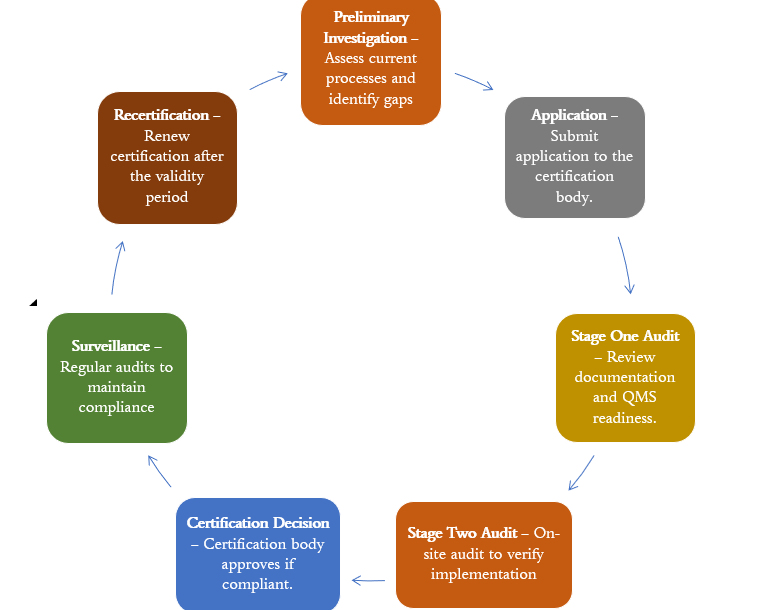
- Preliminary Investigation – Assess current processes and identify gaps.
- Application – Submit application to the certification body.
- Stage One Audit – Review documentation and QMS readiness.
- Stage Two Audit – On-site audit to verify implementation.
- Certification Decision – Certification body approves if compliant.
- Surveillance – Regular audits to maintain compliance.
- Recertification – Renew certification after the validity period.
QUALITY MANAGEMENT SYSTEM requirements
A quality management system requires a number of essential elements. Here are five of them:
- A quality policy and quality objectives. These statements must be documented.
- A quality manual including scope, justifications for any exclusion, documented procedures and process interaction descriptions. This will specify how a QMS will be observed and emphasize the company’s commitments to both continuous improvement and quality.
- Any document procedures required by the compliance standard.
- Any documents needed to ensure the effective operation, planning and control of company processes.
- Records such as evidence of conformity to requirements and of effective QMS operation will be required by the compliance standard.
Activities in QUALITY MANAGEMENT SYSTEM implementation and monitoring
1. Train QMS based ISO 9001:2015 implementers – here the organization require to appoint and train the QMS implementation team. The team will be trained on the requirements of ISO 9001:2015.
2. Document the SOPs and align them with the ISO 9001:2015 standard and other ISO standards.
3. Train QMS internal auditors – at this point the institution trains a team of internal auditors.
4. Carry out internal audits to ascertain the level of conformance to the ISO 9001:2015 requirements
5. Apply for certification from an accredited body e.g. KEBS, BSI 6. Undertake continuous improvement i.e. get feedback, undertake management reviews, revise the QMS and recertify the institution. C